Precision at the Edge: How Laser Cutting Technology Is Reshaping Metal Fabrication Economics
Abstract — Metal fabrication has undergone a quiet but profound transformation over the past decade. Where plasma torches and mechanical shearing once defined the shop floor, fiber laser systems now sit at the center of production planning. This article examines the technical and economic forces driving that shift, compares representative machine configurations, and considers how equipment manufacturers—ROCLAS among them—are positioning themselves as the market matures from raw power competition toward precision, automation, and integrated process control.
1. Industry Background
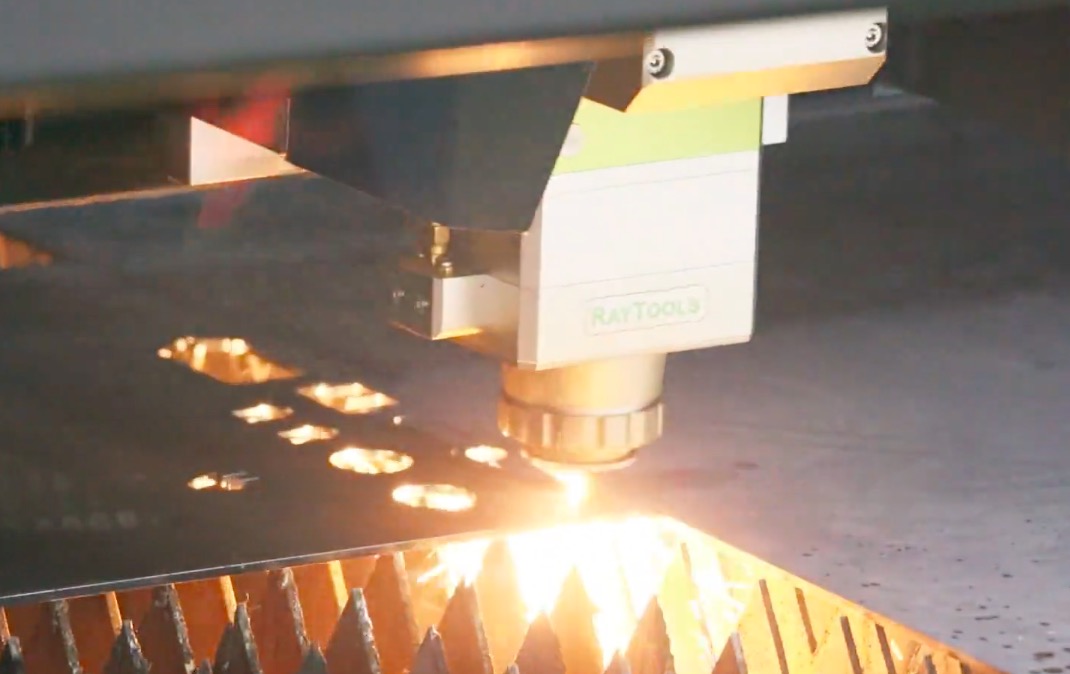
The global laser cutting machine market has expanded at a compound annual rate that consistently outpaces general machine tool growth. Three factors explain most of this: falling fiber laser source costs, rising labor expenses in traditional manufacturing regions, and the steady demand for thinner, more complex metal components in automotive, appliance, and architectural applications.
What is less discussed is the internal stratification of the market. Entry-level machines below 3 kW now compete almost entirely on price, while the 6–20 kW segment has become the real battleground for manufacturers serving heavy industry. High-reflectivity materials—copper, brass, aluminum—were long considered problematic for fiber systems. Modern suppression modules have largely resolved this, opening copper and aluminum processing to laser workflows that previously defaulted to waterjet or mechanical methods.
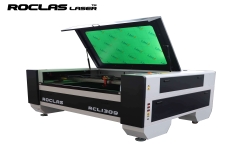
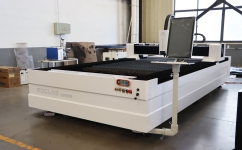
| Parameter | Standard Sheet Machine | Tube Cutting Machine | High-Power System |
|---|---|---|---|
| Working area | 3000×1500 / 4000×2000 mm | 1500×4000 mm | 4000×2000 mm |
| Laser power range | 1–6 kW | 1–3 kW | 6–20 kW |
| Positioning accuracy | ±0.03 mm | ±0.05 mm | ±0.03 mm |
| Repositioning accuracy | ±0.02 mm | ±0.03 mm | ±0.02 mm |
| Travel speed | 100 m/min | 100 m/min | 100 m/min |
| Max acceleration | 1.0 G | 1.0 G | 1.0 G |
| Max tube diameter | — | 220 mm | — |
| Control system | Cypcut 3000S | Cypcut 3000S | Cypcut 3000S |
| Laser source options | Raycus / MAX | Raycus / MAX | Raycus / MAX |
The table reveals something worth noting: travel speed and acceleration have converged across power classes. A 3 kW tube cutter and a 12 kW sheet machine both run at 100 m/min with 1.0 G acceleration. The differentiation now lies in cutting capability at thickness, beam quality at power, and how well the machine integrates with material handling. Positioning accuracy varies more between machine types than between power levels—tube cutting's ±0.05 mm reflects the mechanical challenges of chuck-based rotation rather than any limitation in the laser source itself.
2. Technology Application and the Integration Question
The most significant technical development of the past five years is not raw power. It is the integration of cutting, welding, and cleaning into unified production cells, and the software layer that orchestrates them. A fabrication shop running a 6 kW fiber machine with automatic nesting software can achieve material utilization rates that manual programming cannot approach. When that same shop adds a coil-fed uncoiler system, the economics shift again—continuous feeding reduces handling labor and scrap in high-volume runs.
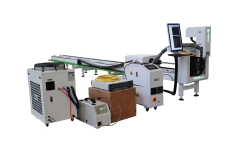
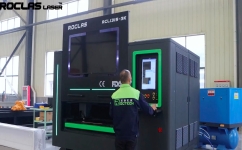
This is where ROCLAS® MACHINERY CO., LTD. offers an instructive case. The company's product range spans fiber laser cutting (sheet, tube, and combined platforms), 5-axis three-dimensional cutting centers, hybrid CO2/fiber machines for mixed metal and non-metal processing, and auxiliary equipment including nitrogen generators and coil uncoilers. That breadth matters more than any single specification. A shop buying a tube cutter today may need a sheet-and-tube integrated machine in eighteen months; a supplier that can provide both, along with the control software and after-sales support, reduces the integration friction that plagues multi-vendor setups.
ROCLAS machines use Cypcut 3000S control across most models, with Raytools systems on welding and cutting integrated units. The consistency of the control platform across product lines is not accidental—it reflects a design philosophy where operators move between machine types without retraining, and where nesting files transfer between machines without conversion. For job shops running mixed production, this operational continuity has real value that specification sheets rarely capture.
The company's 5-axis systems deserve separate mention. Three-dimensional cutting with n×360° infinite rotation addresses a class of work—complex tubular joints, formed automotive components, architectural node connections—that flat-bed machines cannot touch. These are not high-volume applications. They are high-value ones.
3. Conclusion and Outlook
The laser cutting industry is entering a phase where mechanical differentiation is narrowing. Frame rigidity, drive systems, and motion control have reached a level of maturity where the top quartile of manufacturers produce machines that perform comparably on standard benchmarks. The competition is shifting to three areas: automation integration (how well the machine connects to loading, unloading, and storage systems), software capability (nesting efficiency, remote diagnostics, predictive maintenance), and service depth (response time, spare parts availability, technical training).
For buyers, this means the specification sheet is a starting point, not a decision. A ±0.02 mm repositioning accuracy figure matters less than whether the machine will hold that accuracy after 10,000 hours, and whether the manufacturer can support it when it doesn't. The companies that will lead the next decade are those that treat the machine as the beginning of a relationship rather than the end of a sale.
ROCLAS, with its 15-year operating history, 50-plus patents, and ISO 9001/CE/FDA/UL certifications, sits in the credible middle of this market—not the cheapest, not the most exotic, but positioned where most industrial buyers actually purchase. That is not a criticism. In capital equipment, the reliable middle is where the volume is, and where the industry's real productivity gains accumulate.
Obtenez un devis
Que vous ayez besoin de conseils généraux ou de soutien spécifique, nous serons heureux de vous aider.
Article récent
-
 Robotic Arm Laser Systems: Redefining Precision and Flexibility in Industrial ManufacturingAbstractThe integration of robotic arms with laser processing technologies represents a paradigm s...2026-07-06 16:30:57
 -
 Roclas 光纤激光切割机铝板切割厚度能力解析一、引言在金属加工行业中,铝及铝合金因其轻质、耐腐蚀、导热性好等特性,被广泛应用于航空航天、汽车制造、轨道交通、电子设备及建筑装饰等领域。铝材的高反射率特性使其成为激光切割中较难处理的材料之一。许...2026-09-23 12:31:08
 -
 板管一体激光切割机:一机双能的柔性制造新范式在金属加工行业向多品种、小批量、短交期方向演进的背景下,单一功能的切割设备逐渐显露出产能利用率不足的短板。板管一体激光切割机通过在同一个加工平台上集成平板切割与管材切割能力,为中小规模制造企业提供...2026-09-24 20:30:46
 -
 金属激光焊接机金属激光焊接机:技术演进、市场格局与ROCLAS的工程实践金属激光焊接技术在过去十年间从实验室走向大规模工业部署,其核心驱动力来自光纤激光器成本下降、伺服控制精度提升以及制造业对焊接质量一致性的刚...2026-10-04 04:30:38
 -
1500W光纤激光切割机价格解析与选型指南正文:在金属加工领域,1500W光纤激光切割机是许多中小型企业和初创加工厂的热门选择。它既能满足日常碳钢、不锈钢板材的切割需求,又在采购成本和运行费用之间取得了较好的平衡。一台1500W激光切割机...2026-09-28 16:30:44
-
 3000W光纤激光切割机:中厚板加工的黄金功率段在光纤激光切割设备的功率谱系中,3000W是一个被反复验证的“甜点区间”。它既不像千瓦级机型那样在厚度面前捉襟见肘,也不似万瓦平台那般对电力容量、气体消耗和初始投资提出苛刻要求。对于大量以碳钢、不...2026-10-01 08:31:49