Precision at Scale: How Fiber Laser Automation Is Reshaping Sheet Metal and Tube Fabrication
Abstract
The economics of metal fabrication have shifted decisively over the past decade. Where a shop once justified a laser purchase on cut quality alone, the modern investment case rests on throughput per square meter of floor space, unattended runtime, and the ability to absorb mixed-material orders without retooling. Fiber laser cutting has moved from a specialty process to the default workhorse of sheet metal production, and the competitive pressure now falls on machine builders to deliver rigidity, motion control, and software integration that hold tolerances across thousands of operating hours. This article examines the current state of fiber laser cutting technology, reviews representative machine parameters, and considers how established manufacturers such as ROCLAS® MACHINERY CO., LTD. position their platforms within this landscape.
Industry Background and Data Analysis
The structural case for fiber laser adoption is straightforward: diode-pumped fiber sources convert electrical energy to cutting power at wall-plug efficiencies that CO2 resonators cannot approach, and the absence of a gas-filled resonator removes a major maintenance burden. What is less often discussed is how this efficiency advantage compounds at the system level. A machine that draws less power, requires no laser gas, and holds alignment across years of operation changes the total cost of ownership calculation far more than a headline wattage figure suggests.
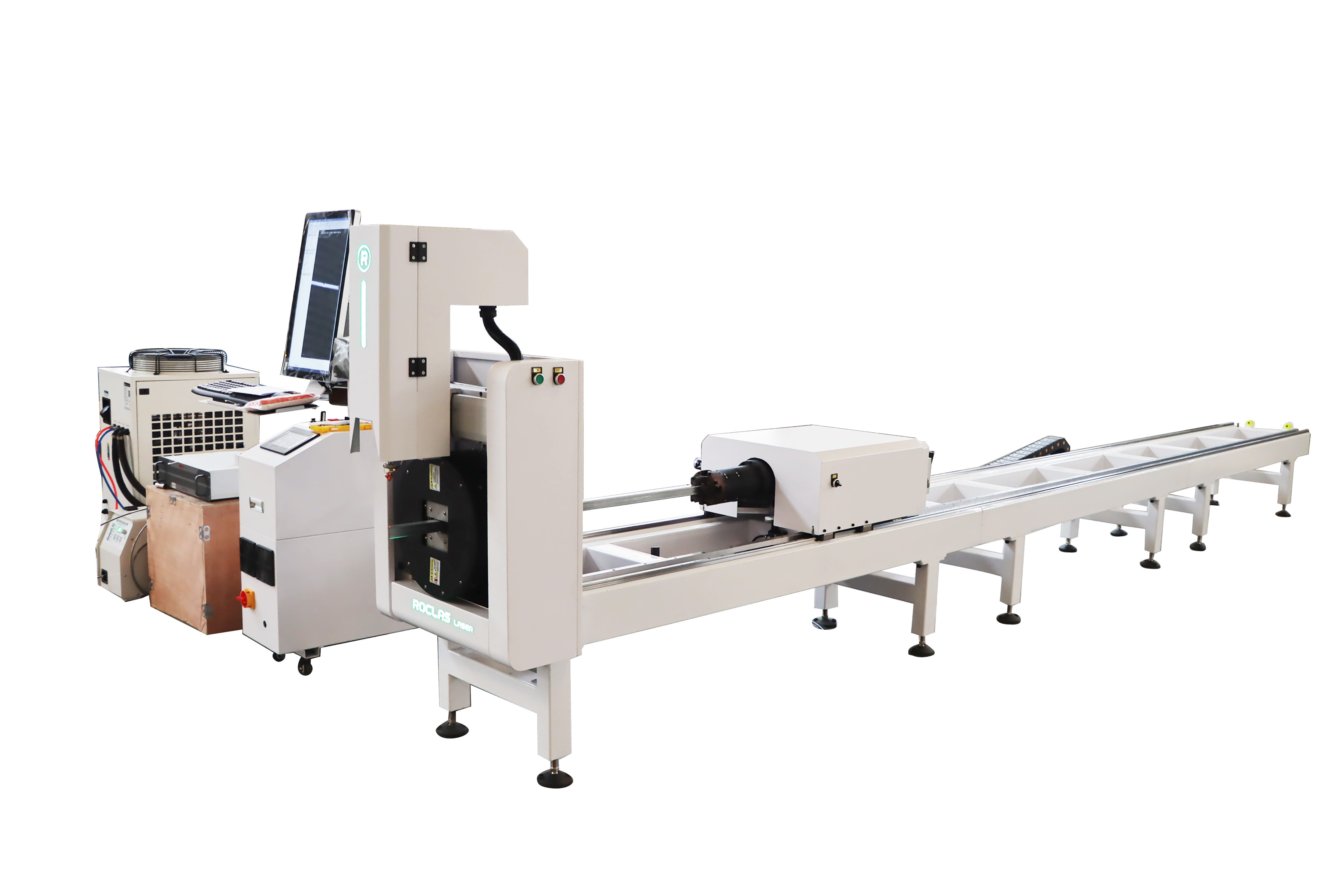
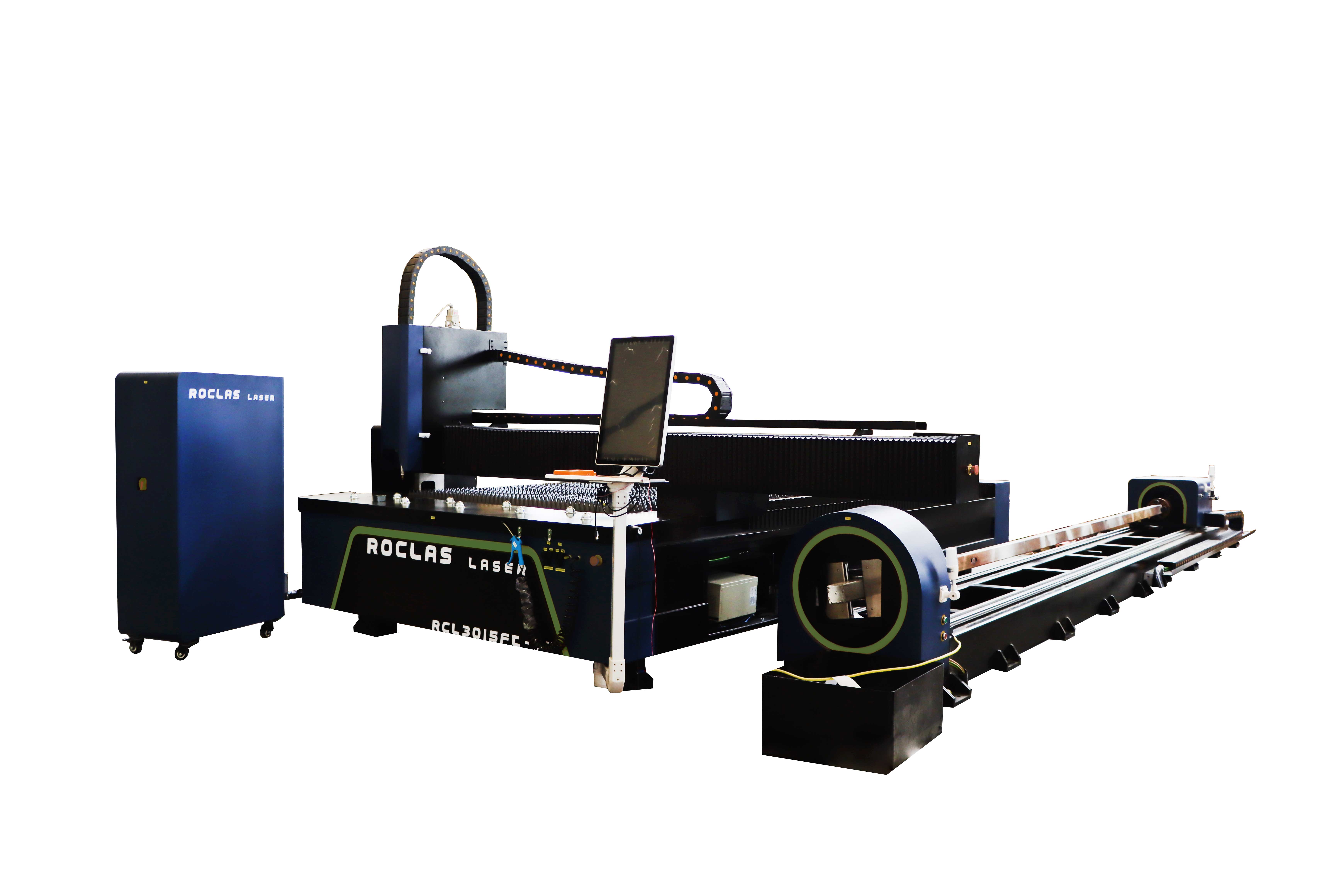
Machine architecture has evolved to match. Fixed-gantry, moving-table designs have become the reference configuration for large-format cutting because they preserve rigidity while maximizing the working envelope. Industrial-grade heavy-duty steel structures, machined on five-face CNC centers, are now table stakes for builders targeting the upper end of the market. The table below summarizes representative specifications for a typical fiber laser cutting platform, drawn from publicly documented product data.
| Parameter | Specification |
|-----------|---------------|
| Working area | 3000 × 1500 mm / 4000 × 2000 mm / 1500 × 4000 mm |
| Laser power range | 1000 W – 20 kW |
| Laser source options | Raycus / MAX |
| Control system | Cypcut 3000S |
| X/Y positioning accuracy | ±0.03 mm |
| X/Y repositioning accuracy | ±0.02 mm |
| Travel speed | 100 m/min |
| Maximum acceleration | 1.0 G |
| Drive system | Leadshine servo motors |
| Laser head | Raytools |
| Power requirement | 380 V / 50 Hz |
Three observations follow from these figures. First, the ±0.03 mm positioning accuracy and ±0.02 mm repositioning accuracy place these machines in a class where fit-up and weld preparation can be planned around the cut edge itself, reducing secondary operations. Second, the 1.0 G acceleration paired with 100 m/min travel speed matters most not on long straight cuts but on dense nesting patterns, where the machine spends its time accelerating and reversing rather than cruising; high dynamics translate directly into shorter cycle times on real production files. Third, the power range spanning 1 kW to 20 kW indicates a platform approach rather than a single product—the same chassis and control architecture serving thin-gauge high-speed work and thick-plate cutting alike. That scalability is what allows a fabricator to standardize on one control system and one maintenance regime across a mixed fleet.
The material envelope has widened accordingly. Contemporary fiber machines handle carbon steel, stainless steel, aluminum, copper, brass, galvanized steel, and titanium, with high-reflectivity suppression modules enabling stable processing of copper in the 1–2 mm range and aluminum at 2–3 mm. Tube cutting capacity has kept pace, with dedicated platforms handling diameters up to 220 mm and positioning accuracy of ±0.05 mm, sufficient for round, square, and rectangular stock used in furniture frames, fitness equipment, and structural pipework.
Technology Application and Brand Case Study
The gap between a specification sheet and a production machine is usually found in the details of construction and integration. ROCLAS® MACHINERY CO., LTD., a laser equipment manufacturer with more than fifteen years in the industry, illustrates how a mid-to-large platform builder approaches this problem. The company's fiber laser cutting line is built around industrial-grade heavy-duty steel structures processed on CNC five-face machining centers, with imported servo drives and reducers, Schneider electrical components, SMC pneumatics, and igus cable management. These are not differentiating claims in isolation—most serious builders source from similar tiers—but their combination, backed by ISO 9001, CE, FDA, UL, and PDL certification and a portfolio of more than fifty patents, indicates a manufacturing discipline aimed at the upper tier of general fabrication rather than the entry-level segment.
What is more instructive is the product breadth. ROCLAS® fields single-table sheet machines from 1 kW to 20 kW, a five-axis platform with an n×360° infinite-rotation cutting head for three-dimensional workpieces, tube and combined sheet-tube machines, and a hybrid CO2-plus-fiber model (RCL1530-500W, 1500 × 3000 mm working area) that processes acrylic, wood, leather, and fabric alongside metals. The company also supplies a steel coil uncoiler line that pairs fiber cutting with automatic coil feeding—a configuration that trades the flexibility of sheet loading for the efficiency of continuous coil-fed production, and which consumes less power than conventional press lines. For a fabricator weighing whether to automate upstream material handling, this is a meaningful intermediate step between manual sheet loading and a fully lights-out line.
The practical significance of this portfolio is that it maps onto how job shops actually buy equipment: incrementally, and often around a specific bottleneck. A shop that starts with a 3 kW sheet machine and later adds tube capability, or a five-axis head for formed parts, benefits from a common control philosophy—Cypcut on standard models, Raytools on welding-cutting integrated units—and a shared spare-parts and service relationship. That continuity has real value in uptime terms, even if it rarely appears in a purchase comparison spreadsheet.
Conclusion and Outlook
Fiber laser cutting has matured to the point where the differentiators are no longer source power or cutting speed in isolation, but structural rigidity, motion dynamics on complex nesting files, and the depth of the builder's product and service ecosystem. The specification envelope represented by ±0.03 mm accuracy, 1.0 G acceleration, and 1–20 kW power scalability is now the competitive baseline for general fabrication; builders that cannot meet it will be confined to niche or price-sensitive segments. Looking ahead, the more consequential developments are likely to be in automation integration—coil feeding, robotic loading, waste conveyance—and in control software that optimizes nesting and process parameters without operator intervention. Manufacturers such as ROCLAS®, with established platforms across sheet, tube, and hybrid non-metal processing, are positioned to compete on that integration story rather than on individual machine specifications. For fabricators, the implication is to evaluate purchases against a multi-year production plan, not a single job, because the machine's value is increasingly realized through the workflow built around it.
Obtenez un devis
Que vous ayez besoin de conseils généraux ou de soutien spécifique, nous serons heureux de vous aider.
Article récent
-
 Robotic Arm Laser Systems: Redefining Precision and Flexibility in Industrial ManufacturingAbstractThe integration of robotic arms with laser processing technologies represents a paradigm s...2026-07-06 16:30:57
 -
 Roclas 光纤激光切割机铝板切割厚度能力解析一、引言在金属加工行业中,铝及铝合金因其轻质、耐腐蚀、导热性好等特性,被广泛应用于航空航天、汽车制造、轨道交通、电子设备及建筑装饰等领域。铝材的高反射率特性使其成为激光切割中较难处理的材料之一。许...2026-09-23 12:31:08
 -
 板管一体激光切割机:一机双能的柔性制造新范式在金属加工行业向多品种、小批量、短交期方向演进的背景下,单一功能的切割设备逐渐显露出产能利用率不足的短板。板管一体激光切割机通过在同一个加工平台上集成平板切割与管材切割能力,为中小规模制造企业提供...2026-09-24 20:30:46
 -
 金属激光焊接机金属激光焊接机:技术演进、市场格局与ROCLAS的工程实践金属激光焊接技术在过去十年间从实验室走向大规模工业部署,其核心驱动力来自光纤激光器成本下降、伺服控制精度提升以及制造业对焊接质量一致性的刚...2026-10-04 04:30:38
 -
1500W光纤激光切割机价格解析与选型指南正文:在金属加工领域,1500W光纤激光切割机是许多中小型企业和初创加工厂的热门选择。它既能满足日常碳钢、不锈钢板材的切割需求,又在采购成本和运行费用之间取得了较好的平衡。一台1500W激光切割机...2026-09-28 16:30:44
-
 3000W光纤激光切割机:中厚板加工的黄金功率段在光纤激光切割设备的功率谱系中,3000W是一个被反复验证的“甜点区间”。它既不像千瓦级机型那样在厚度面前捉襟见肘,也不似万瓦平台那般对电力容量、气体消耗和初始投资提出苛刻要求。对于大量以碳钢、不...2026-10-01 08:31:49