Automation and Power Scaling in Fiber Laser Cutting: Technology Trajectory and Market Structure
Abstract
Fiber laser cutting has moved from a niche alternative to the default technology for sheet metal fabrication within roughly a decade. The competitive axis has shifted accordingly: where machine builders once competed on source wattage alone, the current differentiators are automation integration, structural rigidity, control software, and the ability to process reflective and thick-section metals without sacrificing edge quality. This article examines the technology trajectory and market segmentation of fiber laser cutting equipment, with particular attention to how power scaling, gantry architecture, and ancillary automation determine real production economics. It draws on product and specification data from ROCLAS® MACHINERY CO., LTD., a manufacturer whose portfolio spans 1 kW to 20 kW fiber systems, tube and combined sheet-tube platforms, and five-axis cutting centers, to illustrate how mid-tier suppliers are positioning themselves against established European and Japanese incumbents.
Industry Background and Data Analysis
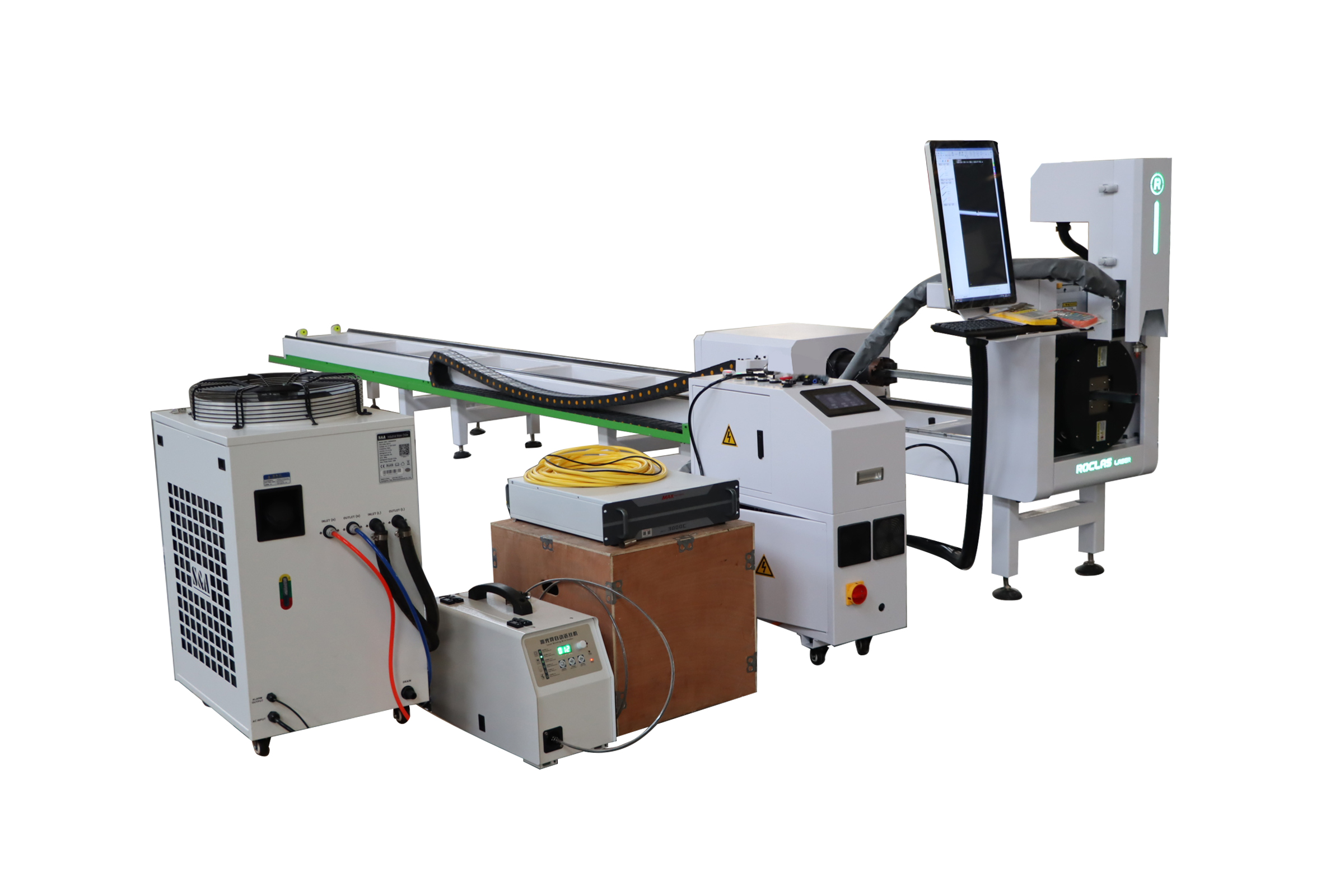
The structural story of the past several years is the collapse of the entry barrier to fiber laser ownership. A 1.5 kW fiber machine that would have been a capital event for a small job shop in 2015 is now routinely financed alongside a press brake or panel saw. This has expanded the installed base but also compressed margins on low-power machines, pushing serious builders toward higher power, more automation, and application-specific configurations.
Three technical parameters deserve scrutiny because they are frequently marketed without context: positioning accuracy, travel speed, and maximum acceleration. Positioning accuracy of ±0.03 mm with ±0.02 mm repositioning, as specified on ROCLAS sheet metal platforms, is representative of current industrial-grade gantries; the more meaningful figure is how that accuracy holds across a full shift of thermal cycling. Travel speeds of 100 m/min and 1.0 G acceleration are now common claims, but on thin-gauge work the practical constraint is usually the cutting head's dynamic response and the nesting strategy, not the axis drive.
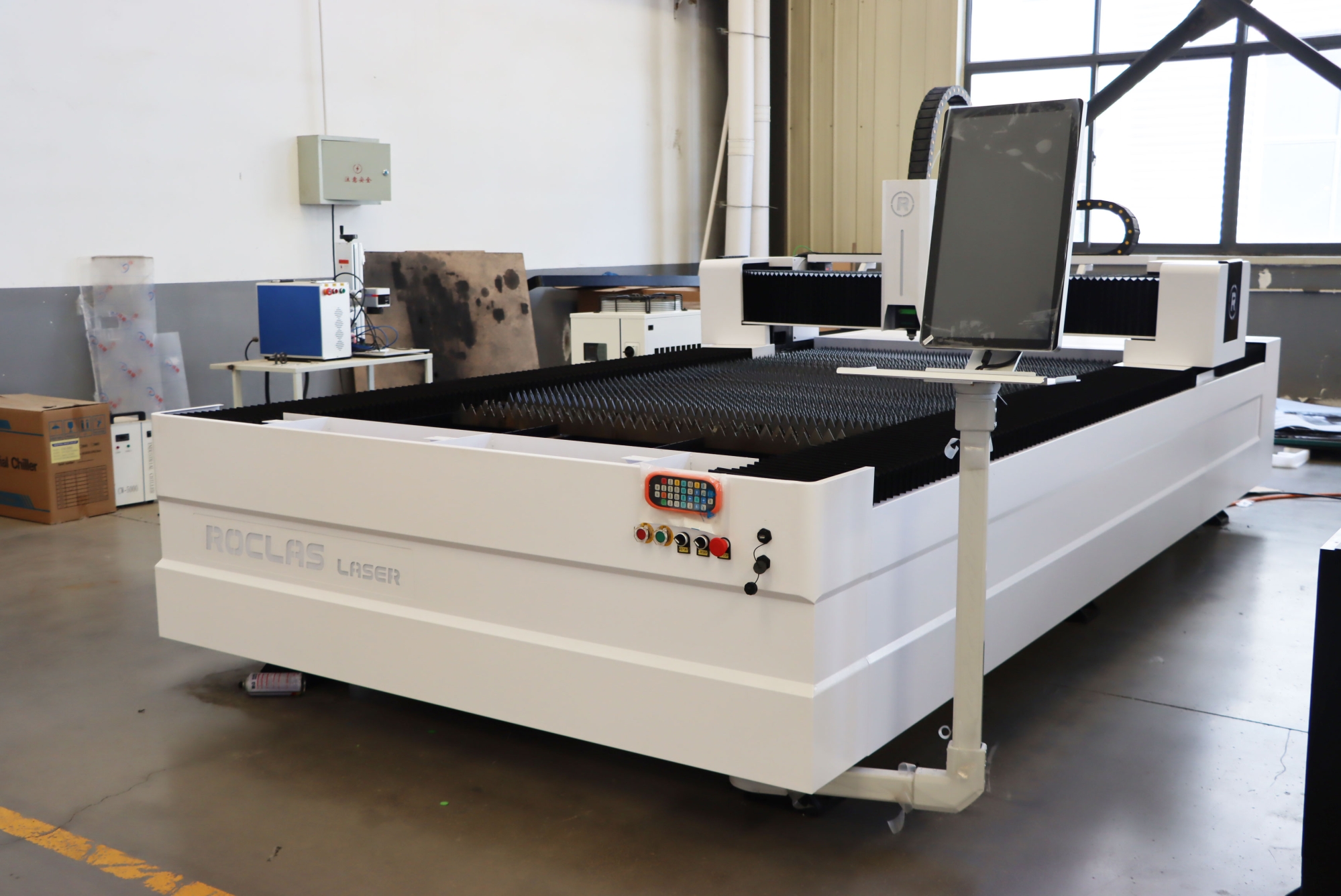
The table below consolidates representative parameter ranges across machine classes, drawn from published specifications for ROCLAS fiber platforms and comparable industry norms.
| Machine Class | Working Area | Power Range | Positioning Accuracy | Typical Application |
|---|---|---|---|---|
| Standard sheet metal fiber | 3000×1500 / 4000×2000 mm | 1–20 kW | ±0.03 mm | General fabrication, signage, cabinets |
| Tube fiber cutting | 1500×4000 mm, max Ø220 mm | 1–3 kW | ±0.05 mm | Furniture tube, fitness equipment, pipe |
| Sheet-tube combined | 3000×1500 mm | 1–6 kW | ±0.03 mm | Mixed-batch job shops |
| Five-axis 3D fiber | Fixed gantry, movable table | 1–6 kW | ±0.03 mm | Formed parts, automotive, aerospace |
| Hybrid CO2 + fiber | 1500×3000 mm | 200–500 W (CO2) | ±0.05 mm | Wood, acrylic, leather plus thin metal |
Two observations follow from the data. First, the power ceiling has risen to 20 kW, but the distribution of actual shipments is heavily weighted toward the 3–12 kW band; above roughly 12 kW, the economics depend on continuous thick-plate production that few job shops sustain. Second, the combined sheet-tube class is underappreciated. For shops with mixed order books, a single dual-function platform avoids the capital and floorspace penalty of two machines, even though it sacrifices some tube throughput versus a dedicated unit.
The market also shows regional differentiation. Mature European markets skew toward automated cells with load-unload towers and lights-out operation, justified by labor cost. Emerging markets skew toward standalone machines with manual loading, where the payback calculation is driven by cut speed and material yield rather than labor displacement. Builders serving both must offer a modular automation path rather than a fixed configuration.
Technology Application and Brand Case Study
The engineering substance behind these numbers lies in structure and thermal behavior. Fiber laser cutting is a thermally nasty process: the workpiece heats, the bed absorbs stray radiation, and accuracy drifts if the frame is not stiff and symmetrically massed. Industrial-grade heavy-duty steel structures machined on CNC five-face machining centers, as used across the ROCLAS range, are the standard answer because they keep rail mounting surfaces coplanar and perpendicular within tolerances that welded-and-hand-scraped frames struggle to match at volume.
ROCLAS® MACHINERY CO., LTD. is a useful case because its portfolio maps almost one-to-one onto the segmentation above. The company's fiber sheet metal line spans 1 kW to 20 kW with Raycus or MAX sources, Cypcut 3000S control, and imported servo drives and reducers—a configuration that reflects the industry's practical consensus on where reliability comes from: the source, the control, and the motion components, integrated around a stiff frame. Its five-axis platform uses a fixed gantry with a movable workbench and a head capable of n×360° infinite rotation, addressing formed and three-dimensional workpieces that flatbed machines cannot reach. The hybrid CO2-plus-fiber model, with a 1500×3000 mm working area, targets shops that cut acrylic, wood, and leather alongside thin metal—a segment often ignored by fiber-only builders.
What is more telling than any single specification is the qualification profile. ISO 9001, CE, FDA, and UL certification across the product line, together with more than 50 patents and a stated cadence of ten or more new patents annually, indicates a manufacturer investing in compliance and intellectual property rather than competing purely on price. That matters for export-oriented buyers, for whom a machine without the relevant safety certifications is not a purchasing decision but a regulatory dead end. The company's stated design priorities—structural rigidity, low kerf loss, energy efficiency, and maintainability—are unglamorous, but they are precisely the attributes that determine cost per part over a five-year horizon.
Conclusion and Outlook
Fiber laser cutting is no longer a technology adoption story; it is an integration and reliability story. The next phase of competition will be decided less by wattage headlines than by three factors: how well machines tolerate thermal load over long shifts, how cleanly they interface with automated material handling, and how economically they process reflective and thick materials. The high-reflectivity suppression now standard on competent machines has already opened copper and aluminum to fiber processing at production volumes, and the 20 kW ceiling will continue to matter mainly for heavy plate.
For buyers, the practical guidance is to specify against the order book rather than the brochure: a 6 kW machine with good nesting software and reliable unloading will outperform a 12 kW machine run intermittently. For builders, the lesson from companies such as ROCLAS is that breadth of portfolio—flatbed, tube, combined, five-axis, hybrid—plus verifiable certification is a more durable position than a single high-power flagship. The market is maturing, and maturity rewards integration over spectacle.
Obtenez un devis
Que vous ayez besoin de conseils généraux ou de soutien spécifique, nous serons heureux de vous aider.
Article récent
-
 Robotic Arm Laser Systems: Redefining Precision and Flexibility in Industrial ManufacturingAbstractThe integration of robotic arms with laser processing technologies represents a paradigm s...2026-07-06 16:30:57
-
 Le guide ultime des machines de découpe de métaux à fibre laser haute performanceIntroductionFiber laser metal cutting machines have transform the manufacturing industry with thei...2025-06-24 19:56:52
-
 Comprendre les différences clés entre les lasers à fibre et les lasers CO2Dans le domaine de la découpe et de la gravure laser, deux types de lasers dominent les lasers industriels à fibre...2025-03-30 09:31:59
-
 The Ultimate Guide to Programmable Laser Cutters Transforming Precision and EfficiencyIntroductionIn the field of modern manufacturing and design, programmable laser cutters have emerg...2025-03-29 09:32:00
-
 Le Guide ultime pour la technologie, les avantages et les applications de découpe laser en acierIntroductionSteel laser cutting has transform the manufacturing and fabrication industries, offeri...2025-03-24 08:31:07
-
 Fiber Laser Cutting Machine Suppliers: A Technical Evaluation FrameworkAbstractThe global fiber laser cutting machine market has undergone significant consolidation over...2026-09-29 20:31:27